Question:
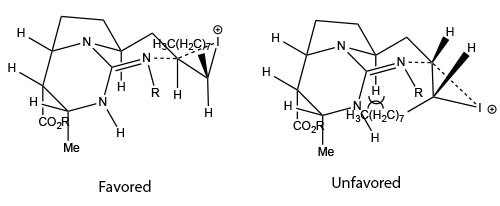
Explain the diastereoselectivity of the iodo-amination step.
The answer comes down to steric hindrance. Basically, the Iodine forms a three membered ring which the Nitrogen atom then opens to form another ring in a reaction known as iodo-amination. The reason for the diastereoselectivity is two-fold. First, the Iodine is going to attack from the right side of the molecule because the bulky nature of the molecule prevents an attack from the left. Second, the large carbon chain attached to the double bond that the Iodine breaks will tend to be positioned in the least sterically hindered position. So when the Iodine attacks, it will favor the reaction shown on the left and not the one on the right which shows unfavorable interactions between the carbon chain and an “axial” hydrogen.Copyright © Web Design by Amani Ramli 2016 Winter SSG