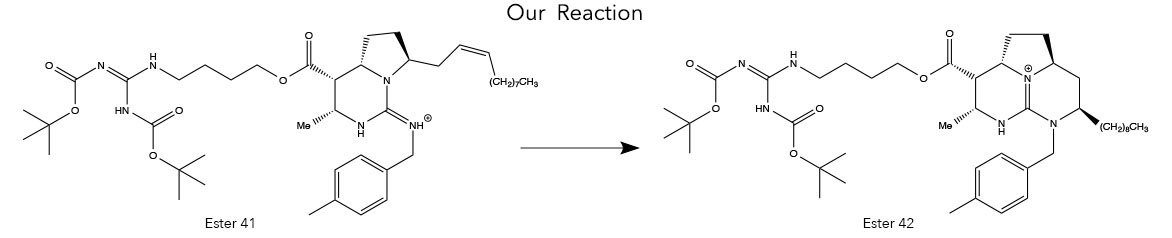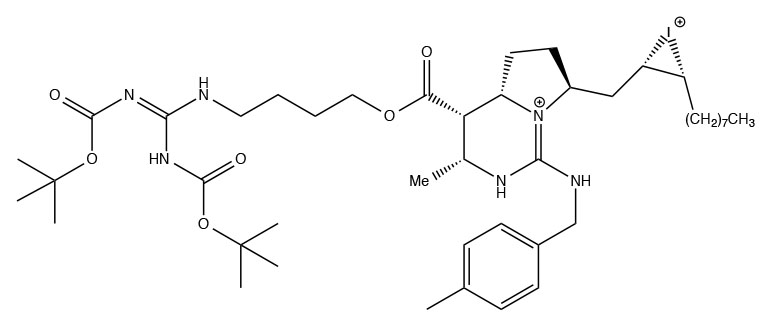
In order for the Orgotar to afford Ester 42 from Ester 41, an intermediate called the Alkyl Iodide (S9) must first be formed. It is the bridge between the two worlds: product and reactant.
Ester 41 to Alkyl Iodide (S9)
Alkyl Iodide (S9)
To a solution of ester 41 (5.0 mg, 0.005 mmol, 1.0 equiv) in dimethoxyethaneActs as a polar aprotic solvent (0.50 mL) at 23ºC was added potassium carbonate Used to deprotonate the Hydrogen atom attached to N-PMB bond (3.0 mg, 0.02 mmol, 4.0 equiv) followed by iodide (6.0 mg, 0.02 mmol, 4.0 equiv). After stirring at this temperature for 24 h, the reaction was quenched with AcOH Acetic Acid
A weak carboxylic acid used to stop a reaction. (0.015 mL), diluted with dichloromethane Acts a polar aprotic solvent. (5 mL), and concentrated in vacuo. A laboratory procedure in which a solid product in a mixture is separated from liquid impurities (such as washes or reagents), using a vacuum to evaporate the volatile liquid (since liquids boil when there is no vapor pressure to keep the substance in liquid form) and leave the pure solid product. The residue was purified by silica gel flash chromatography (3:2 EtOAc/Hex) to afford alkyl iodide S9 (4.0 mg, 70%) as a yellow oil.
Alkyl Iodide (S9) to Ester 42
To a solution of alkyl iodide S9 (3.0 mg, 0.003 mmol, 1.0 equiv) in ethyl acetate (1 mL) at 23ºC was added triethylamine A base that deprotonates to create a E2 reaction kicking off the second Iodine. (0.002 mL, 0.014 mmol, 5.0 equiv) and 10% Pd/C Palladium/Carbon
Used as a metal catalyst for the hydrogenation reaction. (5.0 mg). After the solution was rigorously degassed, a balloon of H2 Used to hydrogenate the newly formed double bond. was inserted. The reaction mixture was then allowed to stir for 4 h. The reaction mixture was then filtered through celite A form of diatomaceous earth used as a filtration aid that helps filter very fine particles that would otherwise pass through or clog a filter paper. and concentrated in vacuo. A laboratory procedure in which a solid product in a mixture is separated from liquid impurities (such as washes or reagents), using a vacuum to evaporate the volatile liquid (since liquids boil when there is no vapor pressure to keep the substance in liquid form) and leave the pure solid product. . The residue was purified by silica gel flash chromatography (9:1 CH2Cl2/CH3OH) to afford guanidine 42 (2.4 mg, 89%) as a yellow oil.
Copyright © Web Design by Amani Ramli 2016 Winter SSG