Provide an explanation for the site selectivity of the C–H bromination
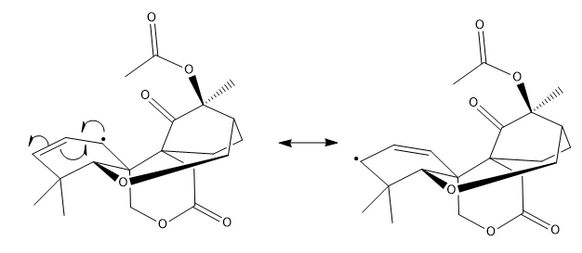
Bromination most readily occurs at a C-H bond that is easily cleaved homolytically. Since the allylic radical that would be formed at the site in the paper is resonance-stabilized, that C-H bond has a lower bond dissociation energy and requires less energy to break homolytically. Bromination would not occur at any of the vinylic hydrogen sites because radicals formed there would be less stable, and the C-H bonds would have higher bond dissociation energies than those at the allylic position. Also, the observed location of bromination occurs at the less sterically hindered site; the other option on the right face of the molecule is crowded with a methyl and ester functional group, decreasing the chances of a reaction occurring there.
Resonance-stabilized allylic radical:
Sources: Höfker, Uwe, Gregor Fels, and Carsten Biele. "Radical Additions and Substitutions with Alkenes." Chemgapedia. Web. 2 Apr. 2015. Carey, Francis. "Radical Substitution Reactions." On-Line Learning Center for Organic Chemistry. Web. 2 Apr. 2015.