
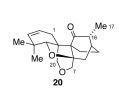
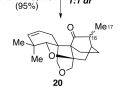
Compare the advantages and disadvantages of synthesizing 20 via intermediate 21 versus via intermediate 19.
The paper includes two ways to synthesize 20. The preferred synthesis is the synthesis of 20 from 18 via 21. There are advantages to this method. Most importantly, the pros of synthesizing 20 via 21 versus 19 have to do with stereoselectivity. As seen in the paper, the carbon number 17 (of a methyl substituent) is not stereoselective in the synthesis via 19 whereas in the synthesis via 21, it is an R stereocenter. In the synthesis via 19, 20 was formed in a 1:1 mixture of isomers, which were inseparable. This lack of selectivity led the authors to devise an alternative that would have better selectivity. There is steric hindrance in the intermediate 21, because of the dithiane group, which serves as a blocking group. This group was subsequently removed using the Raney-Ni. In the synthesis via 19, the blocking group was removed prior, lessening the steric hinderance, allowing the methyl to be in either isomeric position. This reaction not only gives a good yield of 95%, but the stereoselectivity increased dramatically: from 1:1 to >15:1. This results in the methyl 17 group being placed in the correct orientation and allowed the authors to move on to the rest of maoecrystal V. This is a highly advantageous process. The only disadvantage could be that by increasing the sterics in the reaction, it will proceed slower than if there was no steric hinderance.
vs.

Return to the home page: