


REFERENCES:
These are the people who have made the Illuminati's plan possible. You can thank them later.
Reference found in article:
Feichtinger, K.; Zapf, C.; Sings, H. L.; Goodman, M. J. Org. Chem. 1998, 63, 3804-3805.
This paper relates how 21 (N,N’-bis-Boc-N’’-triflylguanadine), with its NTf group and two Boc protecting groups, reacts with a deprotected amine to install a guanidine functional group on 20. Specifically, the article states that in order to add the guanidine group, triethylamine (TEA) is necessary, indicating that the mechanism involves proton transfers via this reactive base. The article also expresses that a triflic amine is produced as a byproduct in the reaction. This suggests that the Tf group acts as a leaving group, allowing the nitrogen of the NTf group to leave and then be protonated by TEA. Additionally, this paper explains the properties of the guanidine group itself. We learned that the guanidine group, due to its basicity, is fully protonated under biological conditions. Since the paper also demonstrated how Boc groups react to protect nitrogen groups, it was deduced how Boc groups are removed. This reaction, along with the reaction to add Tf, produces a high yield, making the formation of the guanidine group very cost effective. Lastly, this paper shows how N,N’-bis-Boc-N’’-triflylguanadine is successful as a reagent, illustrated by the success of the yields in subsequent reactions. Using the N,N’-bis-Boc-N’’-triflylguanadine reagent, the researchers achieved yields averaging at 92% after chromatography.
How TEA is used in the reaction:
First: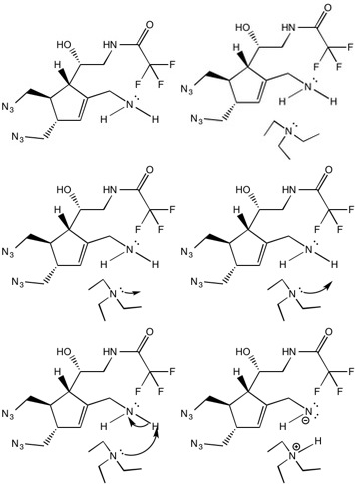 Then:
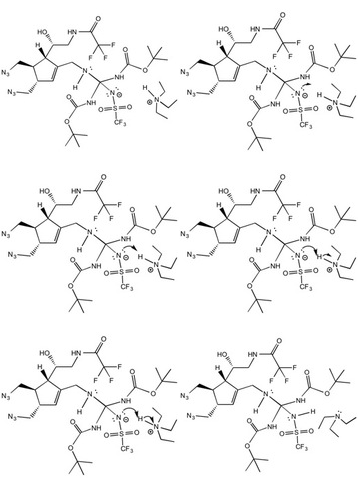
Reference citing our reference #1:
Shubina, T. E.; Freund, M.; Schenker, S.; Clark, T.; Tsgoeva, S.B. Belstein. J. Org. Chem. 2012, 8, 1485-1498.
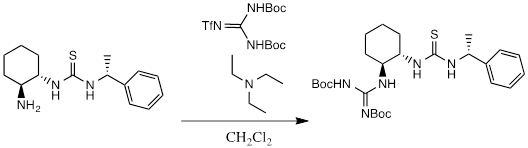
This paper is an example of how N,N’-bis-Boc-N’’-triflylguanadine is used. In this article, an organocatalyst is used in the Michael reaction to form trans-β-nitrostyrene from diethyl malonate. This chemistry is relevant because its mechanism involves the addition of a guanidine functional group via N,N’-bis-Boc-N’’-triflylguanadine.
Reference citing our reference #2:
Jensen, C. M.; Lindsay, K. B.; Andreasen, P.; Skydstrup, T. J. Org. Chem. 2005, 70, 7512-7519.
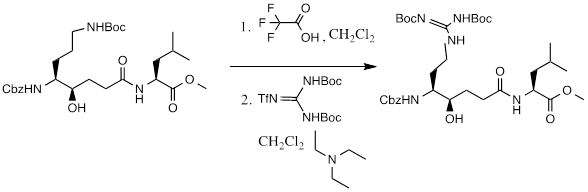
In this article, a hydroxyethylene isostere of the tripeptide Arg-Gly-Leu (a peptide involved in the uPA inhibitor) is synthesized. This article is relevant because the synthesis utilized deprotection of a nitrogen group with TFA and subsequently treated this deprotected group with the N,N’-bis-Boc-N’’-triflylguanadine in one of the final steps of the reaction to add a guanidine functional group.
Reference citing our reference #3:
Baker, T. J.; Luedtke, N. W.; Tor, Y.; Goodman, M. J. Org. Chem. 2000, 65, 9054-9058.
The paper details the synthesis of guanidinotobramycin, a molecule that has been found to prevent the replication of the HIV virus. This paper cited our reference because the mechanism involved in the reaction to produce guanidinotobramycin utilized the N,N’-bis-Boc-N’’-triflylguanadine reagent to effectively convert multiamine-containing glycosides into their guanidinylated derivatives.
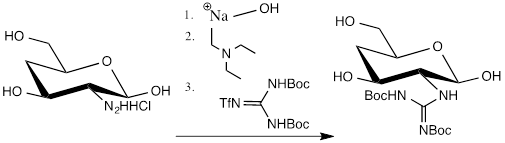
Reference citing our reference #4:
Ma, D.; Pan, Q.; Han, F. Tetrahedron Lett. 2002, 43, 9401-9403.
In this paper, N,N’-bis-Boc-N’’-triflylguanadine was used to obtain enantiopure guanidines that can be used in the Henry reaction to produce biologically important molecules including inhibitors and amino acids. This is another example in which molecule 20 is used to add a guanidine group onto a compound.
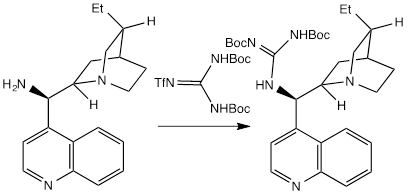
Other References:
- Su, S.; Rodriguez, R. A.; Baran, P. S. J. Am. Chem. Soc. 2011, 133, 13922-13925.
- Feichtinger, K.; Zapf, C.; Sings, H. L.; Goodman, M. J. Org. Chem. 1998, 63, 3804-3805.
- Shubina, T. E.; Freund, M.; Schenker, S.; Clark, T.; Tsgoeva, S. B. Beilstein J. Org. Chem. 2012, 8, 1485-1498.
- Jensen, C. M.; Lindsay, K. B.; Andreasen, P.; Skydstrup, T. J. Org. Chem. 2005, 70, 7512-7519.
- Baker, T. J.; Luedtke, N. W.; Tor, Y; Goodman, M. J. Org. Chem. 2000, 65, 9054-9058.
- Ma, D.; Pan, Q.; Han, F. Tetrahedron Lett. 2002, 43, 9401-9403.
- Forte B., Malgesini B., Piutti C., Quartieri F., Scolaro A., Papeo G. A submarine journey: The pyrrole-imidazole alkaloids. Mar. Drugs. 2009; 7:705–753.