


LEADING QUESTION
Why are researchers interested in pursuing the synthesis of axinellamines?
Apart from mind control, here are some less cool reasons why making these molecules is important.
Axinellamines are bioactive molecules that are part of the pyrrole-imidazole alkaloid (PIA) family, a group of natural products that can be derived from marine sponges. The PIA family of molecules has been shown to have biological properties that range from anti-cancer, antibiotic, anti-inflammatory, anti-microbial, and anti-histaminic abilities. Axinellamines, and corresponding molecules in the PIA family, are synthesized from a simple oroidin molecule that is the biological precursor to these more complex metabolic molecules. The complexity of these molecules make them particularly challenging for researchers to synthesize; in the case of axinellamines, the structure is composed of eight contiguous stereocenters and a cyclopentane ring with substituents at each carbon. While the synthesis of axinellamines had been done before, the challenge facing researchers is creating these products on a larger scale. Deciding to undertake this difficult synthesis is based on the promise of these molecules for their bioactive properties. For instance, Axinellamines B-D are shown to have activity against Helicobacter pylori, a bacteria linked to the development of ulcers and stomach cancer. Developing routes to derive these compounds in the lab have implications for pharmaceuticals and medicine. If researchers are able to devise and simplify methods to create these molecules, their biological activity can then be manipulated to potentially produce medicine, cures, or treatments for various simple and serious ailments.
*Resources used for this question are cited on the references page under the "Other References" section.
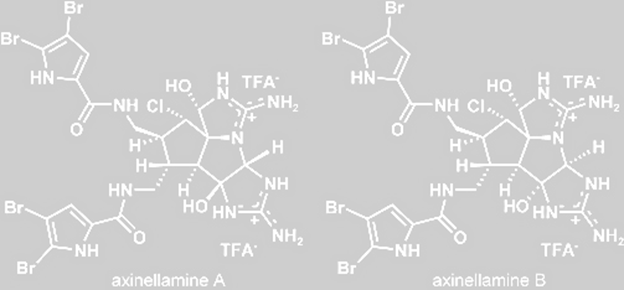
Our leading picture for you:
