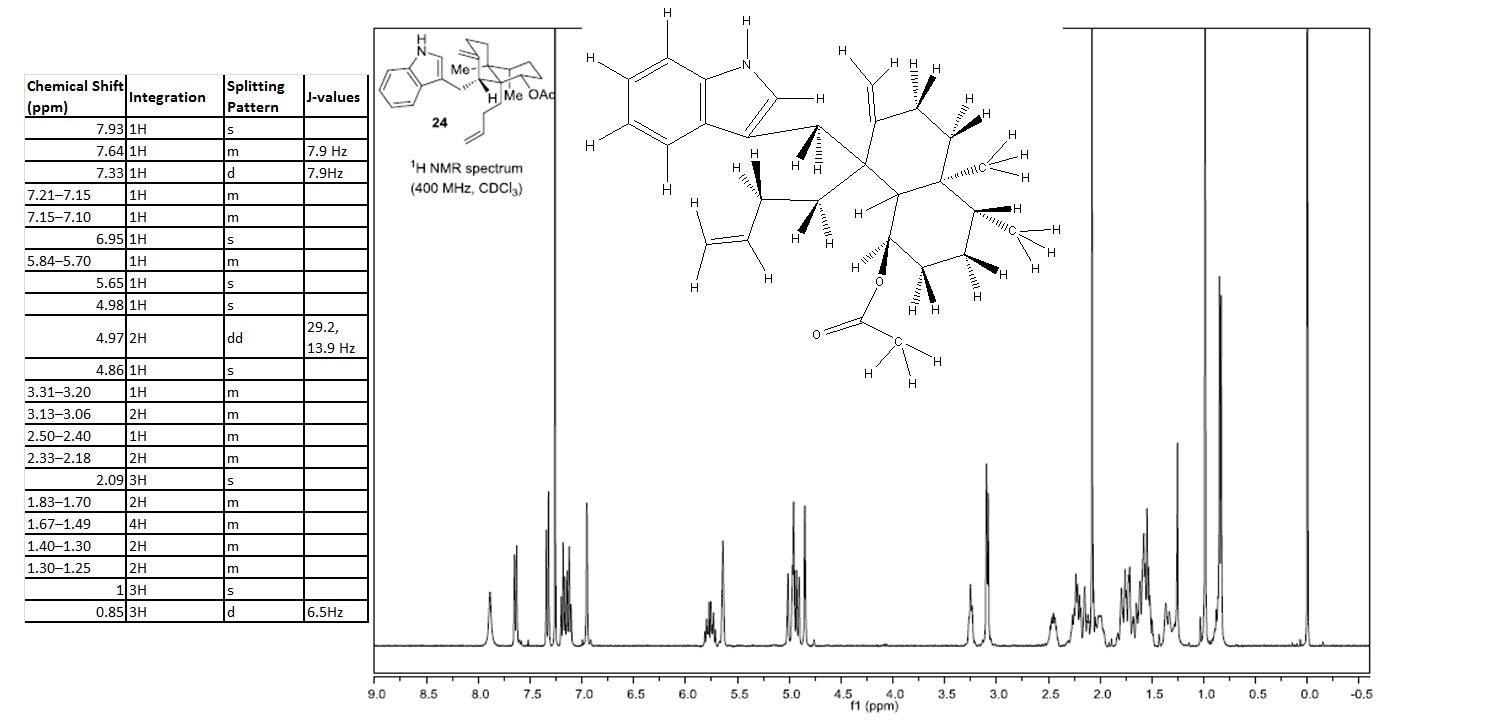
| 7.93 | 1H | s | | This hydrogen shows up very downfield due to the electron withdrawing effect of the nitrogen that it is attached to. Also, this hydrogen does not couple with other hydrogens, so it is a singlet. |
| 7.64 | 1H | m | 7.9 Hz | This is an aromatic hydrogen, so it is downfield. |
| 7.33 | 1H | d | 7.9Hz | This is an aromatic hydrogen. Also, it couples with the hydrogen at 7.15-7.10ppm, causing it to appear as a doublet. |
| 7.21–7.15 | 1H | m | | This is an aromatic hydrogen. |
| 7.15–7.10 | 1H | m | | This is an aromatic hydrogen and it has two neighbors, and it can also undergo meta-coupling. This could cause it to appear as a multiplet. |
| 6.95 | 1H | s | | This is a hydrogen attached to a doublet bond, so it is downfield. It is more downfield than the other hydrogen attached to the double bond (hydrogen at 5.65ppm) because it is closer to the nitrogen. |
| 5.84–5.70 | 1H | m | | This is an alkenic hydrogen, which is a bit more downfield because of the inductive effect of the nitrogen. |
| 5.65 | 1H | s | | This is an alkenic hydrogen. It does not have any three- bond neighbors, so it is a singlet. There might be two-bond coupling present, but perhaps it is too small to observe. |
| 4.98 | 1H | s | | This is an alkenic hydrogen that is not attached to any electron withdrawing groups, so it is more upfield than the other alkenic hydrogens. |
| 4.97 | 2H | dd | 29.2, 13.9 Hz | These are the two other alkenic hydrogens. These couple with each other along with the hydrogen at 4.98ppm giving rise to a doublet of doublets. |
| 4.86 | 1H | s | | This is attached to an sp3 carbon, but that carbon is attached to an oxygen atom. The inductive effect causes this to be more up field than normal sp3 hydrogens. |
| 3.31–3.20 | 1H | m | | This is a hydrogen that is attached to an sp3 carbon. |
| 3.13–3.06 | 2H | m | | This is a hydrogen that is attached to an sp3 carbon. |
| 2.50–2.40 | 1H | m | | This is a hydrogen that is attached to an sp3 carbon. It appears as a multiplet because it couples with the three hydrogens from the methyl group at 0.85ppm as well as long-range coupling. |
| 2.33–2.18 | 2H | m | | This is a hydrogen that is attached to an sp3 carbon. It is a multiplet because it couples with the two hydrogens at 1.83-1.70ppm as well as the hydrogen at 4.98ppm. |
| 2.09 | 3H | s | | This is a hydrogen that is attached to an sp3 carbon. It is a bit more downfield than a normal methyl group due to the inductive effect of the neighboring carbonyl group. |
| 1.83–1.70 | 2H | m | | This is a hydrogen that is attached to a carbon which is attached to two other carbons. This makes the chemical shift a bit higher than 1.0 ppm. |
| 1.67–1.49 | 4H | m | | These four hydrogens are grouped together because they have similar chemical shifts. They would show up as multiplets because they have different neighbors. |
| 1.40–1.30 | 2H | m | | This is a hydrogen that is attached to an sp3 carbon. They show up as a multiplet because they have 3-bond neighbors that are chemically different. |
| 1.30–1.25 | 2H | m | | This is a hydrogen that is attached to an sp3 carbon. They show up as a multiplet because they have 3-bond neighbors that are chemically different. |
| 1 | 3H | s | | This is a normal methyl group, which causes it to have a shift that is about 1.00 ppm. Also, it does not have neighbors to couple with. |
| 0.85 | 3H | d | 6.5Hz | This is also a normal methyl group and it has one neighbor. So, it is a doublet of doublets. |