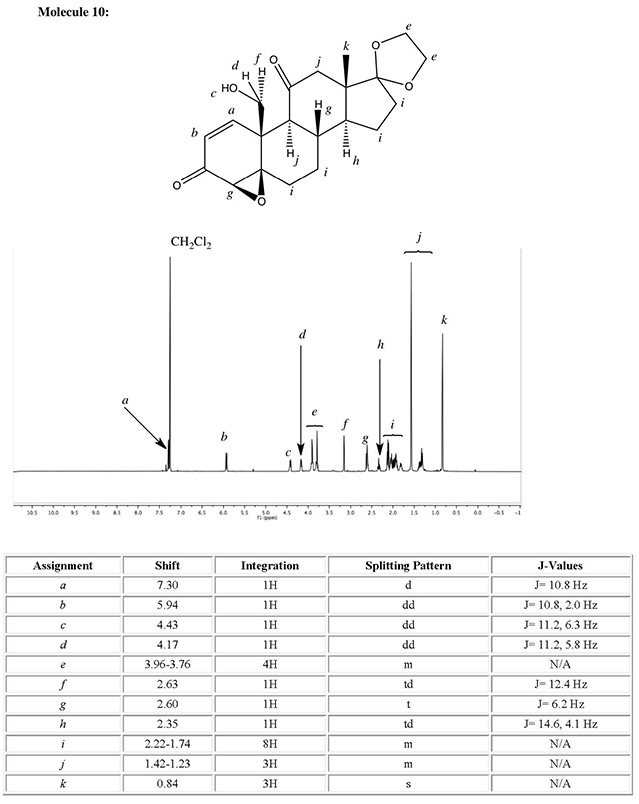
Vincent Vega wants to take you out and show you a good time with some NMR
a: The first peak corresponds to the hydrogen attached to an sp2 carbon. There is also a resonance contributor that further deshields the hydrogen by resonating the double bond to the carbonyl and giving the oxygen a negative charge. There is one hydrogen attached to this carbon and has one neighbor, giving it a doublet splitting pattern.
b: The second peak is also attached to the sp2 carbon and is next to the carbonyl which is highly electron withdrawing. The second peak has one hydrogen with a doublet of doublet splitting pattern. This is most likely due to its single neighbor and long range coupling with the hydrogen across the carbonyl.
c: The third peak is attached to an oxygen which is electron withdrawing. It has one hydrogen and long range coupling with two diasteriotopic hydrogen atoms, giving it a doublet of doublet splitting pattern.
d: The fourth peak has long range coupling with the nearby hydrogens.
e: The fifth peak pertains to identical hydrogens that are connected to carbons bonded to electron withdrawing oxygen atoms.
f: The sixth peak is another hydrogen attached to a carbon bonded to an electron withdrawing oxygen, however, it does not interact with the oxygen sterically, as much as the other hydrogen attached to the same carbon.
g: The seventh peak is a single hydrogen that is connected to an sp3 carbon and does not have any electron withdrawing neighbors.
h: The eighth peak is a single hydrogen that has two identical neighbors and then a different single neighbor, giving it a triplet of doublet splitting pattern. It is also attached to an sp3 carbon without any strongly electronegative neighbors.
i: The ninth group of peaks pertain to eight hydrogens that are all similar in their chemical shifts. These hydrogens are all bonded to carbons with oxygen atoms attached nearby.
j: The tenth group of hydrogens are all bonded to carbons with a neighboring carboxyl group. This carbonyl gives each carbon similar chemical shifts.
k: This last peak is a singlet of three hydrogens that are not close neighbors to electron withdrawing groups, therefore giving it a low ppm.