References
3 Papers Related to Mechanism:
Citation 21:
Hoveyda, A. H.; Evans, D. A.; Fu, G. C. Chem. Rev. 1993, 93, 1307-1370.
Citation 22:Oppolzer, W.; Godel, T. J. Am. Chem. Soc. 1978, 100, 2583−2584.
Citation 24:
Rousseau, G.; Conia, J. M. Tetrahedron Lett. 1981, 22, 649−652.

Citation 21 Expanded upon + 3 papers that have cited citation (21):
Hoveyda, A. H.; Evans, D. A.; Fu, G. C. Chem. Rev. 1993, 93, 1307-1370.
In the article, Hoveyda discusses the effects of different groups near the formation of an epoxide, particularly an alcohol group. He postulates that hydrogen bonding as well as the oxygen’s electronegativity attracts and creates a bias in favor of the shown stereochemistry of the epoxide. In these stereoselective processes, the alcohol group’s participation results in the attack of the more sterically hindered bond. The hydrogen bonding of the alcohol overrides the steric hindrance caused by the group. In the reaction of 28 to 29 the hydroxyl group participates in hydrogen bonding and the polar nature of the oxygen atom attracts the reactant which results in the observed stereochemistry of 29 rather than the mCPBA attacking the less congested double bond on the six-membered ring.
Article 1:
Burns, D. J.; Mommer, S.; O’Brian, P.; Taylor, R.; Whitewood, A. C.; Hachisu, S. Org. Lett. 2013, 15, 394-397.
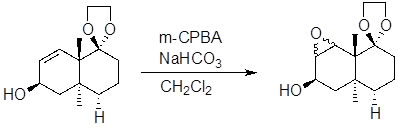
In this reaction, Burns states that, while the trans formation (to the methyl) would be favored sterically,
the alcohol may provide hydrogen bonding and direct the reaction towards cis.
Article 2:
Chen, Z.; Wang, B.; Wang, Z.; Zhu, G. Angew. Chem. Int. Ed. 2013, 52, 2027-2031.
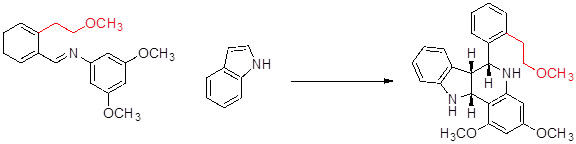
In this Diels-Alder reaction, the addition of the ether (in red) promoted stereoselective formation
of the product most likely due to the ether’s ability to accept hydrogen bonds.
Article 3:
Aydin, G.; Savran, T.; Atkas, F.; Baran, A.; Balci, M. Org. Biomol. Chem. 2013, 11, 1511-1524.
In this article, Aydin forms an epoxide, though his percent yields show the trans forming much
more frequently. This is interesting because it goes against Hoveyda’s findings.