Leading Question
A short review on the conjugate addition reaction of ester enolates:

To teach the force of enolates, Yoda loves.
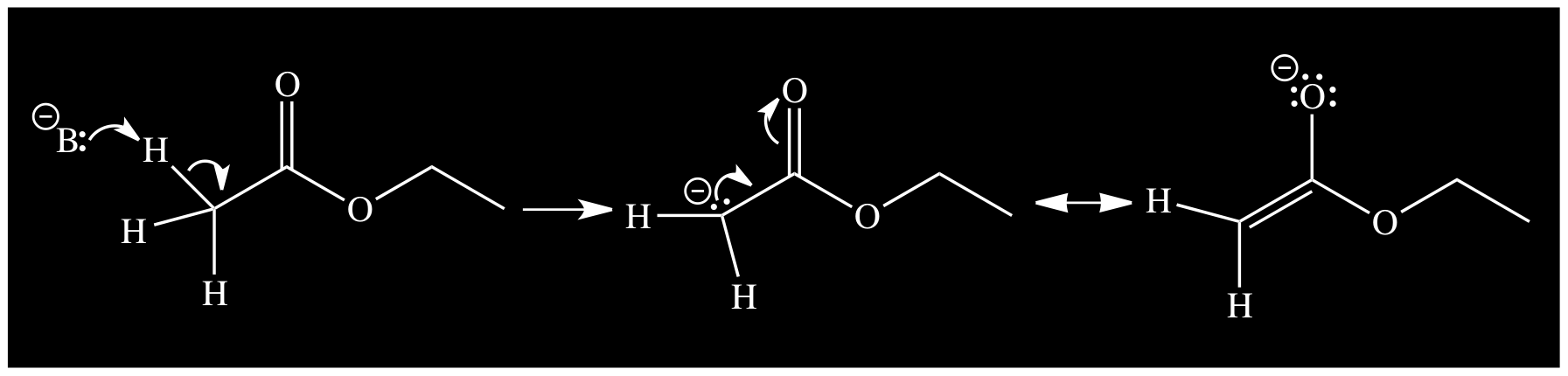
The first part of our mechanism is termed a conjugate additon reaction of an ester enolate . The first requirement for such a reaction is a strong base such as LDA to deprotonate the alpha hydrogen of the carbonyl. After deprotonation, a reactive enolate is formed. The major resonance contributer delocalizes the negative charge onto the more electrongetaive oxygen atom. The enolate is an ambident nucleophile, which means that it can attack from the carbon atom or the oxygen atom. The anionic oxygen generally reacts with acidic hydrogens and silicon compounds. The carbanion preferentially reacts with other electrophiles.
If an enolate is to react with a conjugated carbonyl, there are two possible addition sites. The addition can either occur at the carbonyl carbon to give 1-2 conjugate addion or the beta carbon to give 1,4-conjugate addition. This addition is governed by the pKa of the conjugate acid of nucleophile. If the pKa is below 8, no reaction will occur. If the pKa is between 8 and 25, the 1,4-conjugate addition will take place. If the pKa is above 25, 1,2-conjugate addition will occur. The pKa of the conjugate acid of an enolate is 24, so the model predicts that 1,4-conjugate addition will take place.
References
Koreeda, M. (2013, April 1). Chem 215-216 HH W13 Notes. Retrieved April 10, 2013, from http://www.umich.edu/~chem215/215-216%20HH%20W13%20notes-Ch%2017.pdf
Hunt, I. (n.d.). Chapter 21: Ester Enolates. In Department of Chemistry, University of Calgary. Retrieved April 10, 2013, from http://www.chem.ucalgary.ca/courses/ 351/Carey5th/Ch21/ch21-0.html