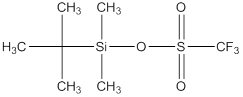
A very strong silylating agent but it’s expensive and doesn’t store well.
Experimental
To a solution of enone 15, 7,7-Dimethyl-7a-(4-(trimethylsilyl)but-3-yn-1-yl)-2,3,7,7a-tetrahydro-1H-inden-5(6H)-one (125 mg, 0.433 mmol) dissolved in CH2Cl2 (4.0 mL) at 0 °C was sequentially added 2,6-lutidine (0.10 mL, 0.86 mmol, 2.0 equiv) and tertbutyldimethylsilyl trifluoromethansulfonate (TBSOTf) (0.13 mL, 0.57 mmol, 1.3 equiv). The resulting mixture was stirred at 0 °C for 90 min before it was poured on NaHCO3 solution (15 mL, sat. aqueous) and the aqueous phase was extracted with pentane (3 x 60 mL). The combined organic extracts were washed with CuSO4 solution (1 x 15 mL), water (1 x 10 mL) and NaCl solution (1 x 15 mL, sat. aqueous), dried over MgSO4, filtered and concentrated under reduced pressure to afford a faintly yellowish oil which was used in the following transformation without further purification. Chromium(VI) oxide (649 mg, 6.50 mmol, 15 equiv) was suspended in CH2Cl2 (4.8 mL) at –20 °C and 3,5-dimethylpyrazole (624 mg, 6.50 mmol, 15 equiv) was added at once. The 13 resulting dark red suspension was vigorously stirred at that temperature for 60 min before a solution of the above product (0.433 mmol) dissolved in CH2Cl2 (2.4 mL) was added. The resulting reaction mixture was stirred between –20 °C to –15 °C for 20 min after which NaOH solution (2,4 mL, 5.0 M aqueous) was added and vigorous stirring as continued for additional 20 min between –15 °C to –5 °C. The organic phase was diluted with diethyl ether (200 mL) and the aqueous phase was separated. The organic phase was washed with HCl solution (1 x 20 mL, 1.0 M aqueous), water (1 x 10 mL) and NaCl solution (1 x 10 mL, sat. aqueous), dried over MgSO4, filtered and concentrated under reduced pressure. Purification by column chromatography (EtOAc/hexane, 20:80) afforded 4,4-dimethyl-3a-(4-(trimethylsilyl)but-3-yn-1-yl)-3,3a,4,5-tetrahydro-1H-inden-1,6 (2H)-dione 17 (86 mg, 66 % for two steps)
Glossary
Tertbutyldimethylsilyl Trifluoromethansulfonate (TBSOTf):
A very strong silylating agent but it’s expensive and doesn’t store well.
Chromium(IV) oxide:

A black crystalline solid used in this reaction to produce Jones’ Reagent
Column Chromatography:
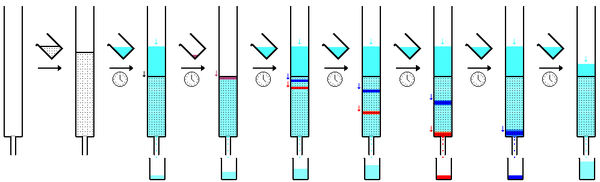
Column chromatography is a technique used to separate a mixed solution of two or more compounds. A slurry of silica gel powder and the eluent is poured into the column and covered with glass wool to prevent the powder being disturbed. The mix of compounds is poured in and the resulting liquid that comes out of the bottom is collected in fractions. These are then analyzed to find the pure forms of each compound in the mix.