Other Papers that cited our mechcanism:
1. Lechel, T.; Gerhard, M.; Trawny, D.; Brusilowskij, B.; Schefzig, L.; Zimmer, R.; Rabe, J. P.; Lentz, D.; Schalley, C.; Reissig, H. Chem. Eur. J. 2011, 17, 7480 – 7491.
-
This article’s citation is relevant because it utilizes the method developed by Lyapkalo and Vogel in their original article. This particular method allows direct conversion of 5-acetyloxalozole into alkyne with an excellent yield percent. The main article’s method is directly used in this article.
2. Vogel, M. A. K.; Stark, C. B. W.; Lyapkalo, I. M.; Adv. Synth. Catal. 2007, 349, 1019-1024.
-
This article’s reference to the original article is relevant because it uses the methods developed in the original article and other articles in order to create an easy one-step process to get to alkenyl nonaflates from enzolizable carbonyl compounds. Specifically, this article 2 uses P-bases from the original article.
3. Boltukhina, E. V.; Sheshenev, A. E.; Lyapkalo, I. M. Synthesis. 2011, 21, 3507- 3515.
-
This article utilizes the information from the original article’s useful discovery to access alkenyl nonaflates by NfF combined with phosphazene bases. This usage of p-bases was also used in the second article as well. By using this method, allows researchers to easily achieve alkenyl products with great yield.
4. Lyapkalo, I. M.; Vogel, M. A. K. Angew. Chem. Int. Ed. 2006, 45, 4019-4023.
-
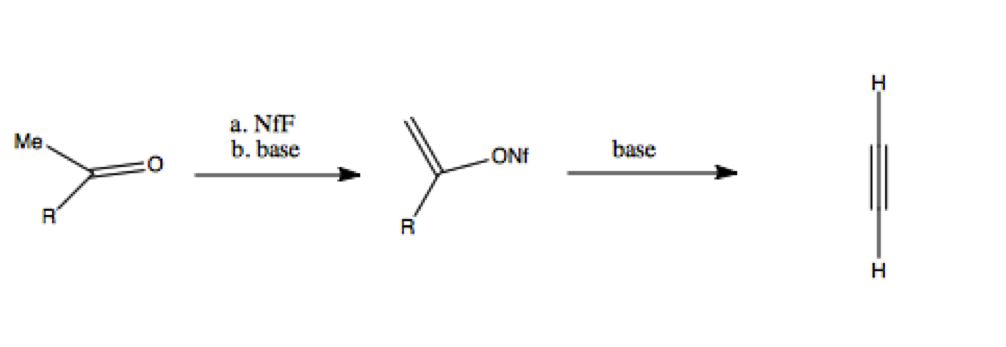
In conversion of Molecule 9 to 10, this particular article provided a direct way of converting methyl ketones into simple, and terminal alkenes. It showed that it is not necessary to isolate and purify alkenyl nonaflates, when the nonaflates are obtained from trimethylsilyl enol ethers and mild sulfonylating reagent nonafluorobutane-1-sulfonyl fluoride (NfF), under catalysis by fluoride ion. Phosphazene bases were found to be extremely successful bases with NfF because these bases do not react with NfF, yet are strong enough to result in an α-deprotonation of the carbonyl substrates, as well as eliminate NfOH in the intermediate alkenyl nonaflates. Combination of these reagents and NfF in an aprotic solvent, such as DMF, allows a direct reaction, or “one-pot reaction,” reaches its highest climax in Sonogashira coupling of the intermediate to give excellent yields of the product. As written in the article, upon addition of phosphazene base, mild sulfonylating reagent, nonafluorobutane-1-sulfonyl fluoride (NfF) in dry DMF to methyl ketone 9 successfully produced the terminal alkyne 10 with 92% yield. (Illustration of this mechanism below).

^BACK TO HOME