| Fairly Odd Reaction Home | Mechanism | HNMR | Experimental | Glossary of Terms | References | Leading Question | About Us | SSG Home |
.jpg)
Molecule SI-30
(75.0 mg, 0.268mmol)IBXwas added to a solution ofalcohol 139(80.0 mg, 0.117 mmol) in (2 mL) of DMSO at room temperature. More IBX (8.0 mg, 0.028 mmol) was added after 1 hour. The mixture stirred for an additional 45 minutes at room temperature and then the reaction mixture was loaded onto silica gel and purified quickly byflash chromatography(14 X 1.5 cm column, 4:1 hexanes: EtOAc containing 2% Et3N), forming aldehyde SI-30 as a yellow oil. (57.0mg, 71% yield) 1H NMR (500 MHz, CDCl3): δ 9.19 (d, J = 2.9, 1H), 7.29 (d, J = 8.6, 2H), 6.88 |
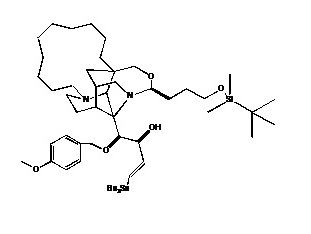
Molecule 140
(760 µL of a 2.3 M solution in hexanes, 1.75 mmol) was added dropwise to a solution of (E)-1,2-bis (tributylstannyl)ethane8 (1 mL, 1.94 mmol) in THF (4 mL) at –78 °C. The reaction remained at –78 °C for 10 min, and then was warmed to –40 °C for 1 h. Then, the reaction mixture was cooled again to –78 °C and transferred via cannula to flask containing MgBr2 (715 mg, 3.88 mmol) already cooled to –78 °C. The resulting mixture was simultaneously stirred and warmed to 0 °C over 45 min. The mixture stayed at 0 °C for 10 min, and then the suspension was cooled to –5 °C. This suspension is Grignard 137, and is used in the subsequent transformation.
Grignard 137 (500 μL, of a 0.5 M solution in THF, 0.25 mmol) was added to SI-30 (19.5 mg, 0.031 mmol) in THF (500 μL) at –20 °C. After 30 min, additional Grignard reagent 137 was added (500 μL), then added again after 1 h (500 μL) after the start of the reaction. The reaction was quenched by the addition of saturated aqueous NaHCO3 solution (1.5 mL) and H2O (5 mL) 30 min after the final addition of the grinard reagent. The resulting mixture was extracted with EtOAc (4 x 1.5 mL) and then washed with brine (1 mL)and dried by passage over a plug of SiO2 (EtOAc eluent). The crude product was formed by evaporation under reduced pressure and then purified via flash chromatography (hexanes containing 2% Et3N; then 9:1 hexanes:EtOAc containing 2% Et3N) to create the purified vinyl stannane 140 (21.0 mg, 68%) as a ~3–4:1 ratio of isomers. Spectral data is reported for the major isomer.
1H NMR (500 MHz, CDCl3): δ 7.26 (d, 2H), 6.85 (d, J = 8.6, 2H), 6.39 (d, J = 19.3, 1H), 6.28 (dd, J = 4.3, 19.1, 1H), 4.80 (d, J = 11.1, 1H), 4.46 (d, J = 11.1, 1H), 4.39 (d, J = 4.4, 1H), 4.10 (m, 1H), 3.85 (s, 1H), 3.80 (s, 3H), 3.58 (m, 2H), 3.29 (m, 2H), 3.15 (d, J = 9.3, 1H), 3.11 (s, 1H), 3.02 (m, 1H), 2.82–2.55 (m, 4H), 2.2–1.2 (m, 41H), 0.92–0.8 (m, 24H), 0.02 (s, 6H); 13C NMR (125 MHz, CDCl3): δ 158.9, 151.5, 131.2, 128.8, 126.8, 113.6, 88.2, 85.7, 80.1, 74.4, 72.7, 68.7, 66.2, 63.4, 59.4, 55.2, 50.4, 43.9, 42.4, 40.9, 38.9, 38.6, 38.4, 33.9, 29.7, 29.1, 27.7, 27.3, 25.9, 25.7, 25.3, 25.1, 24.3, 23.5, 22.3, 21.5, 18.3, 13.7, 9.4, –5.3; LRMS-ESI (m/z) [M + H]+ calcd for C52H88IN2O4Sn, 1001; found, 1001.