|
TECHNICAL
REPORT ON THE OCTOBER 2001 FIELD EXPEDITION TO LAKES NYOS AND MONOUN,
CAMEROON Report
of the U.S. OFDA Technical Project, Cameroonian Nyos-Monoun Degassing
Program (NMDP)
George
Kling, University
of Michigan, Ann Arbor MI 48109, USA William Evans, U.S. Geological Survey, Menlo Park CA 94025, USA Gregory Tanyileke, IRGM, BP 4110, MINREST, Yaounde, Cameroon November 2001 EXECUTIVE
SUMMARY (1)
A degassing pipe was installed in Lake Nyos in February
2001 by the NMDP, and it has been in continuous operation since March
2001. In October 2001 we
investigated the effects of degassing on (a) the lake stability, (b)
the CO2 concentrations in the air near the degassing pipe
and on the shore of the lake, and (c) the environmental changes in the
lake ecosystem. (2)
The stratification in Lake Nyos has changed very little since
the continuous gas removal began in March 2001.
The main structure and stability of the density layers in the
lake remains the same as before the degassing.
The dense, degassed water that is released at the surface of
the lake is being rapidly diluted and mixed into the upper water
column. There is no
indication that the lake stability has been weakened, and the dense
water released by the pipe is not descending from the surface and
penetrating or disturbing the chemocline at 50 m depth. (3) The CO2 released by the pipe is mixed rapidly with the atmosphere, and the CO2 concentration in air around the lake has remained well below the threshold value for long-term exposure in humans (0.5%). The CO2 concentration close to the pipe opening is usually also below the long-term threshold value, and always remains below the short-term threshold value for exposure in humans (3%). Thus there is no threat to air quality from the CO2 released by the pipe. (4) The bottom water being pumped up and released at the surface has caused a reduction in the lake water clarity. This expected reduction is caused by the precipitation of an iron-hydroxide mineral when dissolved iron from the bottom water contacts oxygen at the surface, and also by the stimulation of algal growth due to the release of nutrient-rich bottom water at the surface. Oxygen levels in the upper 10 m of the water column have increased somewhat due to this algal growth. We found no evidence of any harmful effects on the biota (e.g., fish) of the lake. (5)
At Lake Monoun the gas pressure and stability of stratification
have changed little since our last measurements in January 2001.
Gas levels in Monoun bottom waters remain high and dangerous,
and immediate degassing is critical for the safety of people living
around the lake. I.
EFFECT OF DEGASSING ON LAKE STABILITY The NMDP has stressed that an important consideration of the degassing program is the overall safety associated with the process of gas removal. To ensure that gas removal is proceeding safely, it is imperative that the water-column structure and stability are monitored. This monitoring is accomplished by measuring the gas content of bottom waters, and the temperature and conductivity profiles within the lake. The monitoring is done in part by automatic observations by equipment installed in the lake, and in part by the Cameroonian scientists and technicians operating at the lake as permanent staff of the NMDP. The Cameroonian constructed facilities at the lake have and will be critical for the success of the program (see Section III of this report). (1)
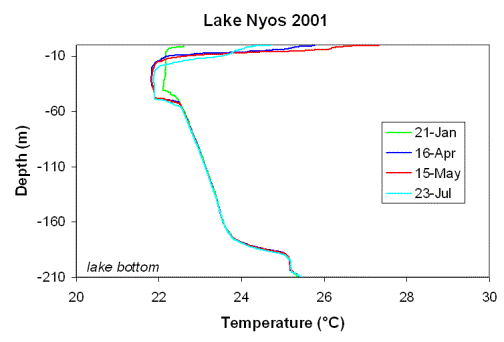
Temperature Cameroonian scientists have measured the full depth profile of temperature and conductivity (CTD profiles) several times since continuous piping began. The temperature profiles over time are shown in Figure 1. Above 50 m depth the profiles show the natural variation expected due to seasonal changes in climate. The warm temperatures in the upper 20 m result from solar heating of the surface layer during the spring and summer. The sharp jump in temperature at 50 m depth corresponds to the chemocline, below which the water contains increasing quantities of CO2 and dissolved salts with increasing depth. Below 50 m depth, the profiles are very similar to one another over time, and strongly resemble the profile that existed in January 2001 prior to the initiation of degassing. Thus there is no indication that the thermal structure of the lake has been disturbed by the degassing.
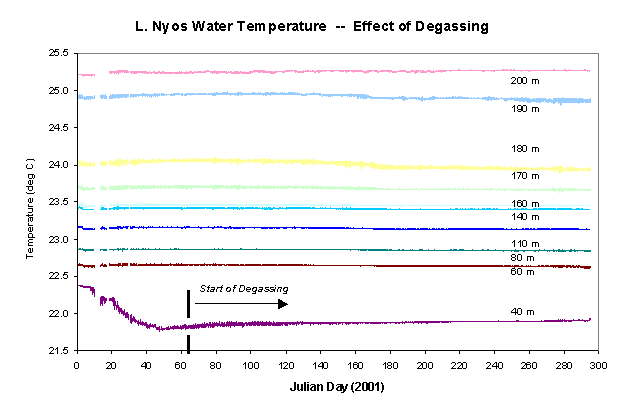
Figure 1. Temperature versus depth in Lake Nyos (measured by Seabird CTD). In addition to the profile measurements, the climate monitoring station measures temperature at 14 depths in the lake every 30 minutes. Figure 2 below shows the record of temperature at depths below 40 m from the time before degassing (January � February) and since continuous degassing commenced in March of 2001. It is clear that the temperatures of depths beneath the surface are stable over time. This indicates that first, the pipe mouth and water withdrawal at ~203 m has caused no major change in the thermal structure of the lake, and second, the degassed (but still dense) water released at the surface of the lake is not creating plumes of dense water that descend into the lower lake levels. The very slight deviations in the deepest temperatures are due to changing lake levels.
Figure 2. Water temperature data from the climate monitoring station for selected depths (40-200 m) in Lake Nyos. (2)
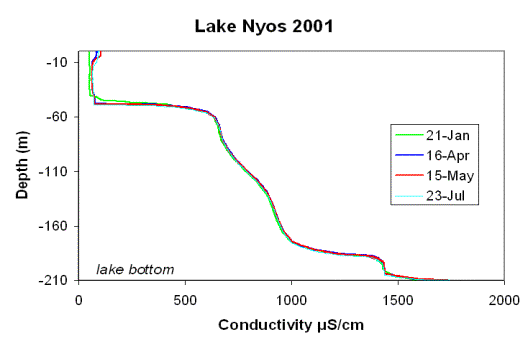
Conductivity A second measure of the stability of stratification in the lake is the electrical conductivity of the water. Conductivity results from dissolved salts in the water, and thus conductivity serves as a proxy for water density; higher conductivity means higher density. The three conductivity profiles are shown in Figure 3. The chemocline at 50 m depth is clearly visible, as is the more gradual increase in conductivity with depth below the chemocline. All the profiles are similar to the pre-degassing profile from January, except for a small increase in the conductivity of surface water from values of 40-50 μS/cm to 80-100 μS/cm after the piping began. The conductivities we measured in surface water this October (2001) were also in the range of 80-100 μS/cm. Apparently, a balance between the continuous inflow of dilute stream water and the discharge of high-conductivity bottom water has already been established, and surface water conductivities are remaining much less than 500 μS/cm, the value just below the chemocline. The chemocline will thus remain a strong barrier to an uncontrolled gas release.
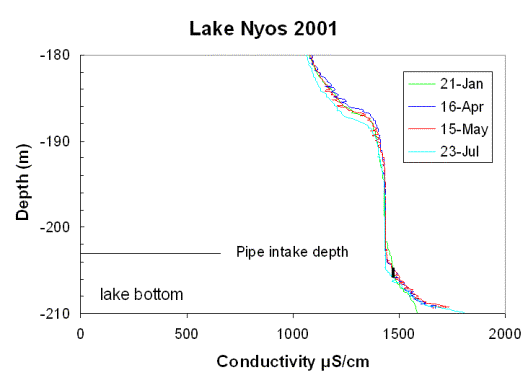
Figure 3. Water conductivity versus depth in Lake Nyos (measured with Seabird CTD). Viewed in greater detail, the conductivity profiles show the beneficial effect of the degassing project. Figure 4 shows an expanded view of the conductivity in the bottom 30 m of the water column. By July, the drop in the conductivity profiles (i.e., same conductivity value found at a lower depth) above the intake of the pipe at 203 m could be clearly seen. Much of this drop is due to the continuous removal of gassy water through the pipe. After 15 years of seeing gas buildup and increased hazard at Nyos, this figure presents the first evidence that the lake is actually becoming safer due to the removal of gas.
Figure 4. Expanded view of conductivity in the bottom 30 meters of Lake Nyos. (3)
Gas Pressure The floating climate station at Lake Nyos measures meteorological parameters and water temperature as well as gas pressure at 2 depths. This information allows us to evaluate water-column structure on a continuous basis because the data is transmitted from the station by satellite. This capability has proven useful to check on the degassing situation on a daily basis, and can be used as a backup to the onsite inspections at the lake by the permanent Cameroonian technicians. For example, when recent media reports of mass evacuations in nearby Nigeria were erroneously attributed to problems at Lake Nyos, we were able to make an immediate assessment of the conditions within the lake and show that nothing abnormal had occurred. Although this capability is not as indispensable as it would be in the absence of on-site observers, the combination of continuous data from discrete depths with frequent CTD profiles over all depths is an extremely powerful monitoring tool. The gas pressures at the bottom of Lake Nyos have changed very little since the degassing operation began. Gas pressure at 183 m depth is ~8.0 bar, and at 198 m depth the gas pressure is ~13.0 bar. In part the small change in gas pressure is due to the natural variation in lake level and the coincident changes in water chemistry at any fixed depth below the surface. But in large part we would not expect a substantial change in gas pressure so early after the degassing began. The degassing pipe is removing only slightly more gas than is naturally recharging into the lake each year, and so the gas pressures at the bottom will change only slowly over time. Although the lake is not becoming more dangerous with time, it is still imperative that more pipes are added to Lake Nyos in order to reduce the gas pressures at a much quicker rate. At Lake Monoun our measurements indicate that there has been little change in the temperature, conductivity, and gas pressure in the lake since our last measurements in January 2001. The gas pressures are still extremely high in the bottom waters, and the need to install a degassing pipe in this lake remains urgent � at present this is the top priority for the NMDP. II.
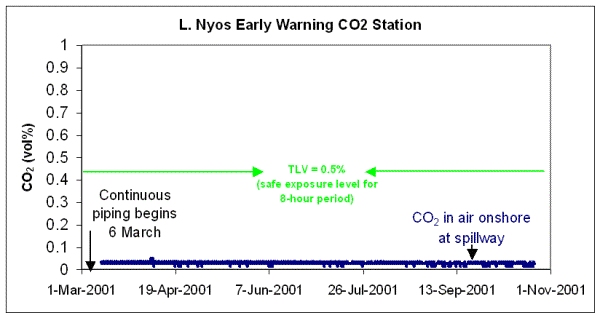
DEGASSING EFFECTS ON LOCAL AIR QUALITY One of the major concerns of the degassing project was that the CO2 released at the surface would create poor air quality conditions in the vicinity of the lake. This field trip allowed us to check and recalibrate the CO2 warning station located on the spillway of Lake Nyos, and to examine the data record from the station in order to address this concern. The station was installed in January 2001 to warn the local population and the scientists and technicians from the hazard of CO2 asphyxiation in the event of a gas release. A detector at the station continuously senses the CO2 concentration in air and will sound an alarm siren if the concentration exceeds 0.5%, which is the Threshold Level Value (TLV) for long-term human exposure that is considered safe by national and international health organizations. Should another uncontrolled gas release occur, the station would detect the CO2 before the cloud could move into populated areas. The station was also installed to provide an extra measure of safety for the degassing operation. The degassing pipe currently vents nearly 100 tonnes of CO2 per day to the atmosphere, a discharge rate comparable to the 20-250 tonnes/day emitted by large natural CO2 vents found elsewhere in the world, particularly in central Italy. Fatalities are known to have occurred in low-lying areas around such vents, raising the possibility that dangerous conditions could develop at Lake Nyos if the CO2 venting from the pipe was not mixed and diluted by the surrounding air. The prevailing wind pattern would strongly favor migration of any such cloud in the direction of the spillway, where the warning station is located. A datalogger in the warning station preserves a record of the CO2 concentration sensed by the detector. Figure 6 shows that record up to 23 October 2001, covering a seven-month period when the degassing pipe was in nearly continuous operation. During the entire period, the maximum CO2 concentration recorded was 0.05% (500 ppmv), a factor of ten below the TLV. The average CO2 concentration at the station remained near the value of 0.036% found in normal air, showing that any CO2 buildup in air around the mouth of the pipe is essentially dissipated by the time that air drifts onshore.
Figure 5. CO2 concentration record in air from the warning station at the Lake Nyos spillway. The 40+ meter height of the fountain seems to help dissipate the released CO2. Cameroonian technicians using handheld CO2 detectors report having detected higher CO2 concentrations at times when the fountain was at the intermediate height, even though the gas discharge rate is much lower then. Although they have detected CO2 concentrations at the raft above the TLV, the values have not exceeded the safe Short-Term Exposure Limit (STEL) of 3% (30,000 ppmv). Thus there appears to be no harmful reduction in air quality either on shore or even around the pipe itself. III.
ENVIRONMENTAL EFFECTS OF DEGASSING
We also investigated the environmental effects of the degassing operation, which were in general the most difficult to predict in advance. For example, the discharge of degassed bottom water onto the lake surface had the potential for negative effects on the fish in the lake because the bottom water is anoxic. Bottom water also contains ~150 mg/L of dissolved iron, which reacts rapidly with oxygen and might consume the 6-10 mg/L of dissolved oxygen normally present in surface water. The particulate iron that results from this reaction could reduce the penetration of light into the water column, which may limit the growth of algae. Although this was predicted, it was also expected that the increase in nutrients brought to the surface in nutrient-rich bottom water would offset the lower levels of light and result in similar if not enhanced algal growth after the degassing began. During our investigation we saw no evidence of fish mortality, even though the surface water did have a reddish residue of oxidized iron that was not present before the degassing. Furthermore, the dissolved oxygen concentrations in the uppermost part of the water column, where the fish are feeding, were similar to values measured in previous years (Table 1). Table 1.
Average dissolved oxygen concentrations in the upper 10 m
of Lake Nyos over time.
The dissolved oxygen concentration in the uppermost surface water was about 150% of the saturation value, as high or higher than values normally found at Lake Nyos over the past years of sampling. These high saturation values indicate stimulation of algal productivity, probably as a result of the enrichment of surface waters by nutrients (nitrogen and phosphorus) contained in the degassed water brought to the surface from the bottom of the lake. At the same time, the penetration of light was reduced in the lake compared to the previous measurement before the degassing began (from 3.5 m in January 2001 to 1.4 m in October 2001). This reduction in water clarity is due to a combination of precipitated iron in the surface waters and an increase in the abundance of algae, whose growth was stimulated by the nutrients from bottom water. Although these observed changes are similar to what we had anticipated, it will be important for Cameroonian scientists to continue to monitor surface water quality as the degassing continues. Our results suggest no problems at the present time, but further effort must be made to predict the effects of additional pipes on the surface water quality. IV.
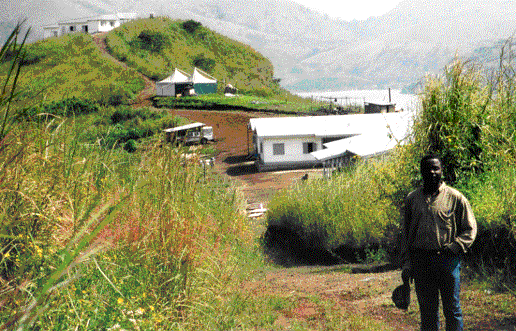
FACILITIES AND FUTURE PLANS The Nyos-Monoun Degassing Program has become a serious priority of the Cameroon Government. Their commitment of resources to the project is demonstrated by the fact that the new road access to Lake Nyos has been maintained through the rainy season, and that permanent buildings have been constructed at the lake. These buildings house workshops, storage areas, sleeping quarters, a kitchen and dining area, and a science observatory that contains a control center and laboratory. Except for the workshops and storage areas, all the buildings are located up on the northeast rim of the Nyos crater, an area with ready access to even higher ground should escape from gas ever be necessary. The entire complex is electrified by a gas-powered generator that will possibly be replaced by a small hydroelectric system through a Japanese aid program. The following pictures indicate the scale of the new buildings and facilities. Figure 6. View from the helipad of the newly constructed sleeping/eating quarters and Science Observatory (at top) on the northeast rim of Lake Nyos. Storage and work rooms (not shown) at lakeside are replacing the tents used in past expeditions.
The lakeside shops and storage areas will greatly facilitate future work at the lake. This work will include the installation of additional degassing pipes, and the continued monitoring of the lake by scientists. The sleeping and eating areas can accommodate large work crews, and the observation room perched at the edge of the crater rim provides a clear view of the degassing pipe and other raft-mounted equipment. Radio control modules in this room can control the piping operations, obviating any need for boating out onto the lake to shut down the flow under any dangerous conditions that might develop. Some permanent buildings have already been framed and roofed at Lake Monoun as well, in preparation for pipe installation at that lake. The Cameroonians have also committed enough resources to this project that at least one technician will be stationed full-time at each of the lakes. This decision on the part of the government alleviates concerns about any dangers that may result from unsupervised piping, such as loss of anchoring. The technicians are trained to operate the pipe control system, but this capability should be augmented with additional training to allow them to make on-site evaluations of the importance of changes in the signals from the many sensors deployed at the lake. Figure 7. View of the degassing pipe from the window of the Science Observatory. 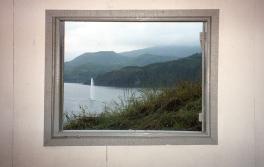
Figure 8. Cameroonian technician M. Issa setting the piping rate from the control raft.
ACKNOWLEDGEMENTS We thank the staff of the Institute of Research on Geology and Mining of MINREST and the staff of the U.S. Embassy for their helpful support in Cameroon. The work conducted during our October 2001 field study was funded by the Cameroonian government and the Interministerial Committee on the Lakes Nyos and Monoun Degassing Project, the U.S. government through an Office of Foreign Disaster Assistance grant to the University of Michigan, by the U.S. Embassy in Yaounde, and by the U.S. Geological Survey.
Last Updated: December 2001 |