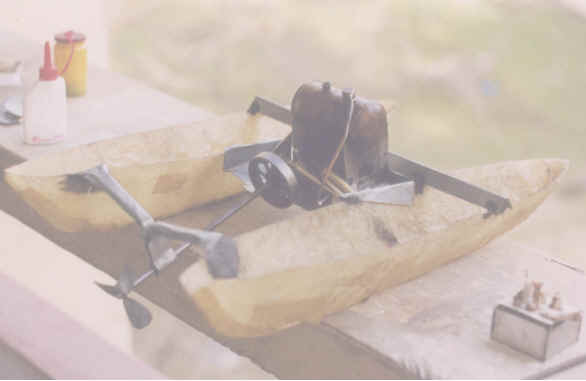
The
goal of this course project was to design, analyze, fabricate and test a
mechanical system: a model size boat with on-board power generation.
Ultimately, the boat was to participate in a boat race and was to be
judged on the basis of speed, endurance and path deviation.
Project
Discussion
The
initial phase of the project was to design and fabricate a steam engine
that could be mounted on the boat. During the conception stage, a premium
was placed on minimizing the weight of the power plant and maximizing the
specific power output. The engine chosen for this purpose was an
oscillating cylinder engine because of its inherent simplicity, since it
eliminates the need for any additional steam inlet and exhaust valves.
There
was an on-board fire-box which was fueled by spirit. This was used to
generate steam in a brass boiler. The steam was led to the miniature
cylinder-piston-crank assembly by means of an insulated brass tube. Care
was taken to avoid heat loss in the transportation of steam. The
crankshaft had a flywheel mounted on it, and also a propeller at the far
end.
The
engine was first tested on pressurized air, and then on superheated steam.
Once the power unit was completed and thoroughly tested, attention was
diverted to the boat design. We chose a catamaran configuration, because
of its stability, low drag and large on-board area for mounting the
engine. The boat hull was made from fiber-glass reinforced epoxy
composite. A mould was made and subsequently the two hulls were cast.
Finally, the entire system was assembled and tested. The performance of
the system was very impressive. Powered by the steam engine, the boat
could cover a distance of 50 meters in water, without any problems of
engine stalling. In the final run the catamaran�s performance was
outstanding in terms of endurance and minimal deviation.